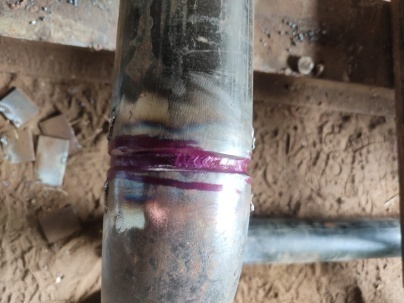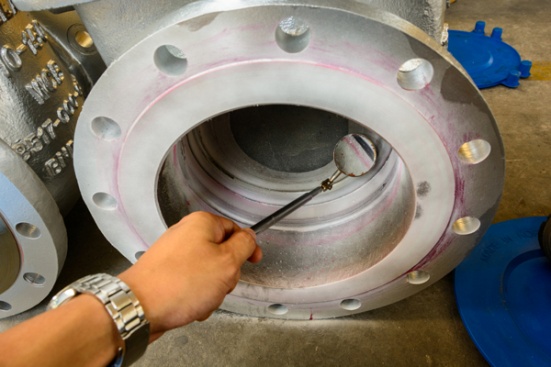
Penetrant Testing
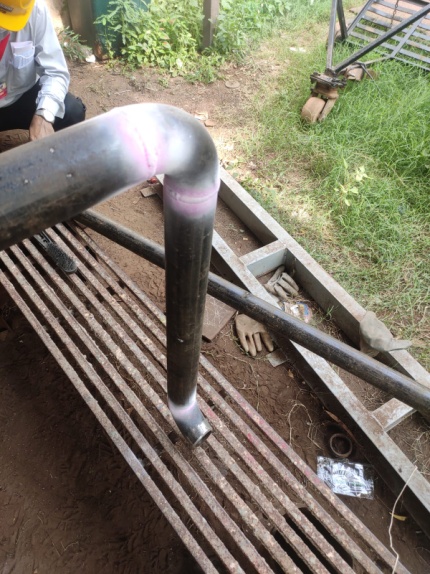
Penetrant Testing
Showing an object's true colours
Dye Penetration Test (DPT) is one of the simplest and oldest Non-Destructive Inspection methods. Also, known as the Liquid penetration test, the Dye penetrant test is widely used to detect surface discontinuities like cracks, fractures, porosity, grinding defects, incomplete fusion, and flaws in joints. This test or inspection method is serving as an aid to finding irregularities in aluminum, cast iron, brass, steel and stainless steel, copper, magnesium, carbides, stellite, ceramics, and even certain plastic materials. So, the dye penetration test is suitable for both ferrous and non-ferrous materials and highly economic as compared to the other non-destructive inspection methods.
PT advantages:
- High sensitivity to small surface discontinuities
- Suitable for large range of materials: metallic and non-metallic, magnetic and non-magnetic, and conductive and non-conductive
- Large surface areas and large volumes parts can be inspected rapidly and at low cost
- Parts with complex geometry can be tested without changing the inspection procedure
- Indications are produced directly on the surface of the part
- Aerosol spray cans make penetrant materials very portable
- Required materials and equipment are relatively inexpensive
PT limitations:
- Only surface breaking defects can be detected
- Only materials with relatively nonporous surface can be inspected
- Precleaning is critical
- Metal smearing from machining, grinding, and grit or vapor blasting must be removed prior to inspection.
- Surface finish and roughness can affect inspection sensitivity
- Multiple process operations must be performed with waiting intervals
- Post cleaning of acceptable parts or materials is required
- Handling and proper disposal of chemicals is required