Oxide scale measurement solution
Oxide scale measurement solution
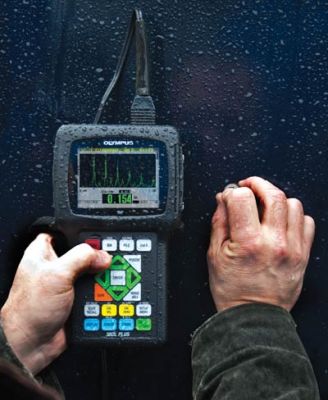
MMS has the latest 38DL PLUS is an advanced ultrasonic thickness gauge. Uses dual element transducer for internal corrosion applications, and has features that include THRU-COAT technology and echo-to-echo. Uses single element transducers for very precise thickness measurements of thin, very thick, or multilayer materials.
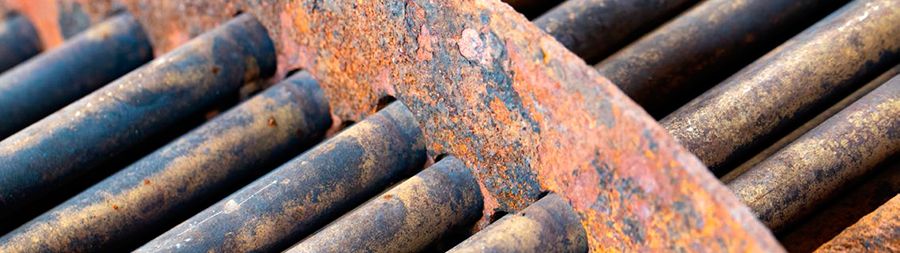
The very high temperatures found inside steam boilers (in excess of 1500 °F (800 °C) can cause the formation of a specific type of hard, brittle iron oxide called magnetite on the inside and outside surfaces of steel boiler tubing. At very high temperatures, water vapor will react with the iron in the steel to form magnetite and hydrogen according to the formula: 3 Fe + 4 H 20 = Fe 3O 4 + 4 H 2
The speed of this reaction increases with temperature. Oxygen atoms will diffuse inward through the magnetite layer, and iron atoms will diffuse outward, so the scale continues to grow even after the tube surface is completely covered.
Magnetite scale acts as thermal insulation on the pipe, since the thermal conductivity of scale is only about 5% that of steel. When heat can no longer transfer efficiently from the flame through the tube into the steam inside, the tube wall will heat up to temperatures beyond the intended operating range. Long-term exposure to overly high temperatures, combined with the very high pressure inside the tube, leads to intergranular micro-cracking in the metal and to creep deformation (a slow swelling or bulging of the metal), which, in turn, eventually leads to tube failure by bursting. A secondary issue is oxide exfoliation, in which pieces of oxide scale break off (usually due to thermal stresses during boiler startup or shutdown). These hard pieces will be carried by the steam flow into the turbine, where, over time, they will cause erosion damage.
The growth of magnetite scale and the associated metal damage are primary limiting factors with respect to boiler tube service life. The process begins slowly and then accelerates; as the scale grows thicker, the tube wall becomes hotter and that, in turn, increases the rate of scale growth and metal damage. Studies in the power generation industry have indicated that the effect of scale is relatively insignificant up to thicknesses of approximately 0.012 in. or 0.3 mm, but that beyond that thickness the negative effects of scale increase rapidly. Periodic measurement of scale thickness enables a plant operator to estimate remaining tube service life and to identify and replace tubes that are approaching the failure point. Ultrasonic testing provides a quick and nondestructive method for measuring scale